

Music Theory Fundamentals
This document covers the essential music theory concepts needed to effectively use Relanote.
Pitch and Frequency
What is Pitch?
Pitch is how we perceive the frequency of a sound wave. Higher frequencies sound "higher" in pitch.
| Frequency (Hz) | Note | MIDI Number | |
|---|---|---|---|
| 261.63 | C4 | 60 | |
| 293.66 | D4 | 62 | |
| 329.63 | E4 | 64 | |
| 349.23 | F4 | 65 | |
| 392.00 | G4 | 67 | |
| 440.00 | A4 | 69 | Concert pitch standard |
| 493.88 | B4 | 71 | |
| 523.25 | C5 | 72 |
The Octave
An octave is the interval between one pitch and another with double its frequency. Notes an octave apart sound "the same" but higher or lower.
C4 (261.63 Hz) → C5 (523.25 Hz) — C5 is exactly 2× the frequency of C4
In MIDI, an octave is always 12 semitones (half steps).
Semitones and the Chromatic Scale
The Semitone (Half Step)
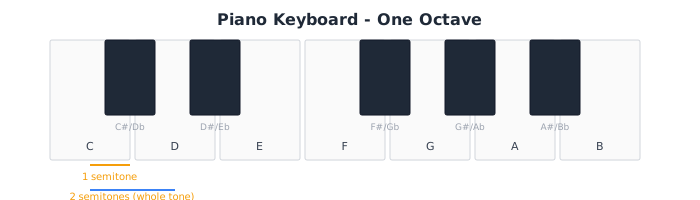
A semitone is the smallest interval in Western music. On a piano, it's the distance from one key to the very next key (including black keys).
The Chromatic Scale
The chromatic scale contains all 12 semitones in an octave:
C → C# → D → D# → E → F → F# → G → G# → A → A# → B → C
    Db       Eb            Gb       Ab       Bb
Intervals
What is an Interval?
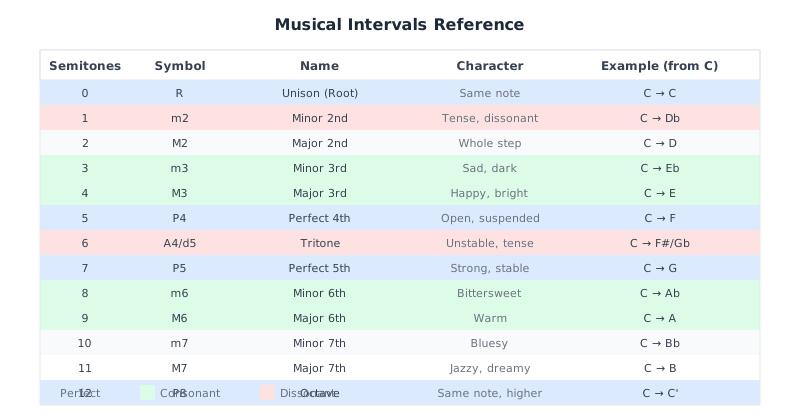
An interval is the distance between two pitches, measured in semitones.
Interval Names
Quality Prefixes
P = Perfect    Used for: unisons, 4ths, 5ths, octaves
M = Major      Used for: 2nds, 3rds, 6ths, 7ths
m = minor      One semitone less than Major
A = Augmented  One semitone more than Perfect/Major
d = diminished One semitone less than Perfect/minor
Why "Perfect"?
The intervals P1, P4, P5, and P8 are called "perfect" because:
- They were considered most consonant (harmonious) in medieval music
- They occur naturally in the harmonic series
- They don't have major/minor variants
Interval Inversions
When you flip an interval (move the lower note up an octave), you get its inversion:
| Original | + | Inversion | = | Total |
|---|---|---|---|---|
| m2 (1) | + | M7 (11) | = | 12 semitones |
| M2 (2) | + | m7 (10) | = | 12 semitones |
| m3 (3) | + | M6 (9) | = | 12 semitones |
| M3 (4) | + | m6 (8) | = | 12 semitones |
| P4 (5) | + | P5 (7) | = | 12 semitones |
Scales
What is a Scale?
A scale is a set of notes arranged in order of pitch. Scales define which notes "belong" together and create a musical context.
The Major Scale
The most common scale, with a bright, happy sound:
Whole-Whole-Half-Whole-Whole-Whole-Half
  W     W    H    W     W     W    H

C Major:  C - D - E - F - G - A - B - C
            W   W   H   W   W   W   H

In intervals from root:
  R   M2  M3  P4  P5  M6  M7  P8
In Relanote:
scale Major = { R, M2, M3, P4, P5, M6, M7 }The Natural Minor Scale
A darker, sadder sound than major:
Whole-Half-Whole-Whole-Half-Whole-Whole
  W    H    W     W    H    W     W

A minor:  A - B - C - D - E - F - G - A
            W   H   W   W   H   W   W

In intervals from root:
  R   M2  m3  P4  P5  m6  m7  P8
In Relanote:
scale Minor = { R, M2, m3, P4, P5, m6, m7 }Comparing Major and Minor
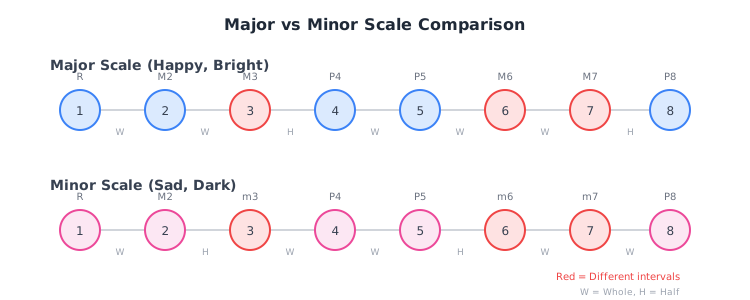
The 3rd degree is the most important difference - it determines if a scale/chord sounds "major" (happy) or "minor" (sad).
Other Common Scales
; Pentatonic scales (5 notes) - easy to improvise with
scale MajorPentatonic = { R, M2, M3, P5, M6 }
scale MinorPentatonic = { R, m3, P4, P5, m7 }

; Blues scale - adds the "blue note" (tritone)
scale Blues = { R, m3, P4, A4, P5, m7 }

; Modes - rotations of the major scale
scale Dorian = { R, M2, m3, P4, P5, M6, m7 }      ; Minor with raised 6th
scale Phrygian = { R, m2, m3, P4, P5, m6, m7 }   ; Spanish/Middle Eastern
scale Lydian = { R, M2, M3, A4, P5, M6, M7 }     ; Dreamy, floating
scale Mixolydian = { R, M2, M3, P4, P5, M6, m7 } ; Dominant, bluesy
The Circle of Fifths
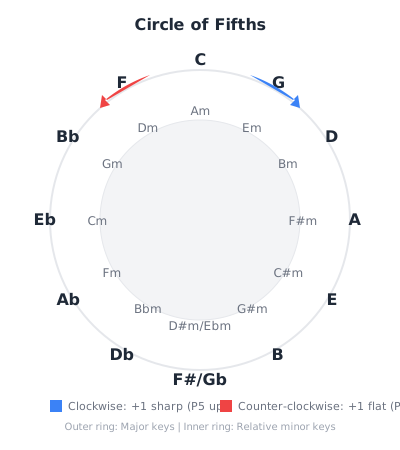
The circle of fifths shows relationships between keys:
Chords
What is a Chord?
A chord is three or more notes played simultaneously.
Triads
The simplest chords are triads - three notes stacked in thirds:
Major triad:     R + M3 + P5    (happy)
Minor triad:     R + m3 + P5    (sad)
Diminished:      R + m3 + d5    (tense)
Augmented:       R + M3 + A5    (unstable)
In Relanote:
chord Maj = [ R, M3, P5 ]
chord Min = [ R, m3, P5 ]
chord Dim = [ R, m3, d5 ]
chord Aug = [ R, M3, A5 ]
Seventh Chords
Adding a 7th creates richer harmony:
Major 7th:       R + M3 + P5 + M7    (jazz, dreamy)
Dominant 7th:    R + M3 + P5 + m7    (blues, needs resolution)
Minor 7th:       R + m3 + P5 + m7    (smooth, mellow)
Diminished 7th:  R + m3 + d5 + d7    (very tense)
Half-dim 7th: R + m3 + d5 + m7 (jazz, bittersweet)chord Maj7 = [ R, M3, P5, M7 ]
chord Dom7 = [ R, M3, P5, m7 ]
chord Min7 = [ R, m3, P5, m7 ]
chord Dim7 = [ R, m3, d5, M6 ] ; d7 = M6 enharmonically
chord Min7b5 = [ R, m3, d5, m7 ]Chord Inversions
Chords can be rearranged by moving the lowest note up an octave:
C Major triad inversions:

Root position:   C - E - G     (R - M3 - P5)
1st inversion:   E - G - C     (M3 on bottom)
2nd inversion:   G - C - E     (P5 on bottom)
Chord Progressions
Common chord progressions in popular music:
I - IV - V - I        (C - F - G - C)     Classic rock/pop
I - V - vi - IV       (C - G - Am - F)    "Axis of Awesome" progression
ii - V - I            (Dm - G - C)        Jazz standard
I - vi - IV - V       (C - Am - F - G)    50s progression
Rhythm
Beat and Tempo
- Beat: The basic pulse of music
- Tempo: Speed of the beat (BPM = beats per minute)
Common tempos:
  60 BPM  = 1 beat per second (slow ballad)
  90 BPM  = relaxed groove
  120 BPM = standard pop/rock
  140 BPM = energetic dance
  180 BPM = fast punk/metal
Note Values
| Name | Symbol | Beats (in 4/4) |
|---|---|---|
| Whole note | 1 | 4 |
| Half note | 2 | 2 |
| Quarter note | 4 | 1 |
| Eighth note | 8 | 0.5 |
| Sixteenth | 16 | 0.25 |
In Relanote, the :n suffix sets duration:
| C4:1 |    ; whole note (4 beats)
| C4:2 |    ; half note (2 beats)
| C4:4 |    ; quarter note (1 beat)
| C4:8 |    ; eighth note (0.5 beats)
Time Signatures
The time signature tells you how beats are grouped:
4/4 = 4 quarter notes per measure (most common)
3/4 = 3 quarter notes per measure (waltz)
6/8 = 6 eighth notes per measure (compound duple)
Relative Rhythm in Relanote
In Relanote, rhythm is relative within blocks:
; 4 notes in a block = each gets 1/4 of the duration
| C4 D4 E4 F4 |

; 2 notes = each gets 1/2
| C4 E4 |

; Mixed with explicit durations
| C4:2 E4:4 G4:4 |  ; half + quarter + quarter
Key Signatures
What is a Key?
A key defines:
- Which scale the music uses
- Which note is "home" (the tonic)
Key Signatures and Accidentals
Key of C Major:  No sharps or flats
Key of G Major:  F#
Key of D Major:  F#, C#
Key of F Major:  Bb
Key of Bb Major: Bb, Eb
Relative Major/Minor
Every major key has a relative minor that shares the same notes:
C Major  ←→  A minor   (no sharps/flats)
G Major  ←→  E minor   (1 sharp: F#)
F Major  ←→  D minor   (1 flat: Bb)
The relative minor starts on the 6th degree of the major scale.
Applying Theory in Relanote
Why Relative Intervals?
Traditional notation uses absolute pitches (C, D, E...). Relanote uses relative intervals because:
- Transposition is free: Change the key by changing one setting
- Patterns are reusable: A melody works in any key
- Relationships are explicit: You see the harmonic structure
; This melody works in ANY key
let melody = | <1> <3> <5> <8> |

; Play in C major
set key C4
melody  ; C - E - G - C

; Play in G major - same pattern, different key
set key G4
melody  ; G - B - D - G
Scale Degrees
Scale degrees reference positions in the current scale:
scale Major = { R, M2, M3, P4, P5, M6, M7 }

; In C Major:
; <1> = C (degree 1 = R = root)
; <2> = D (degree 2 = M2)
; <3> = E (degree 3 = M3)
; <4> = F (degree 4 = P4)
; <5> = G (degree 5 = P5)
; <6> = A (degree 6 = M6)
; <7> = B (degree 7 = M7)
Building Chord Progressions
scale Major = { R, M2, M3, P4, P5, M6, M7 }
chord Maj = [ R, M3, P5 ]
chord Min = [ R, m3, P5 ]

; I - IV - V - I progression
let progression =
  | [<1> <3> <5>] |    ; I   (C major in key of C)
  ++ | [<4> <6> <8>] | ; IV  (F major)
  ++ | [<5> <7> <9>] | ; V   (G major)
  ++ | [<1> <3> <5>] | ; I   (back to C)
Further Reading
- Sound Synthesis: Learn how these musical concepts translate to sound
- Preset Reference: See how theory applies to synth design
- Language Design: Understand how Relanote models these concepts